October 11, 2026 · By the ShopMedRx team
Where to Inject Tirzepatide in Thigh: Spot, Rotation, Storage
Where to inject tirzepatide in thigh: the right spot, how to rotate sites, storage basics, red-skin questions and when to call a clinician. Adults 18+.
By the ShopMedRx team. For adults 18 and older. This article is for education and is not medical advice.
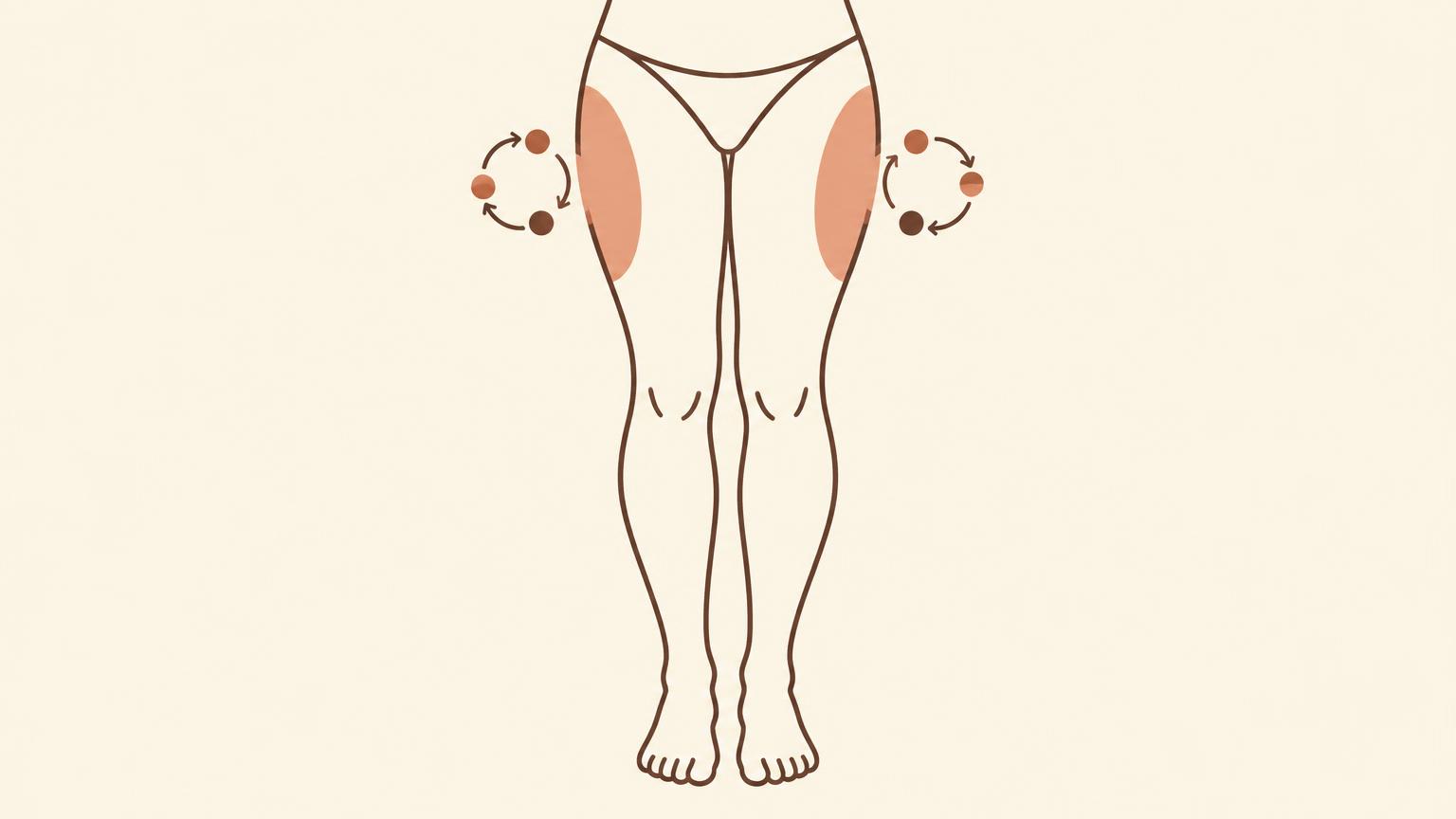
If you are wondering where to inject tirzepatide in thigh, the FDA label lists the thigh as one of the approved subcutaneous injection areas, and general injection guidance usually points to the front or outer part of the thigh, in the layer of fat just under the skin. Many guides suggest avoiding the inner thigh, the area near the knee and the groin. Move to a new spot each week, and always follow the written directions from your prescriber and pharmacy first. Your clinician or pharmacist can confirm the best spot for you.[1]
This guide goes deeper than a general overview. It covers the thigh in detail, how to rotate, how storage works, what a red injection site or a red-looking liquid can mean, and what to ask about extras such as B12 or other add-ons. For the bigger picture on safety and how treatment is prescribed, see our overview, Tirzepatide Explained: Uses, Safety and How to Get It.
Important note about compounded tirzepatide
Tirzepatide is a prescription medicine. A licensed clinician decides whether it is appropriate for you after reviewing your health information. At ShopMedRx, independent clinicians work through OpenLoop Health, and prescriptions are filled by licensed U.S. partner pharmacies.
Many people search for "compounded tirzepatide," "compound tirzepatide" or "tirzepatide compound." A compounded medication is made by a pharmacy for an individual patient. Compounded drugs are not FDA-approved, and the FDA does not review them for safety, effectiveness or quality.[3]
Why this matters for injection advice: the official site and storage instructions people quote online come from the FDA label for an FDA-approved product.[1] Your compounded product may come in a different container, strength or format. Your pharmacy label and your clinician's directions are the instructions that apply to you.
Where to inject tirzepatide in thigh: the exact spot
The FDA label lists three subcutaneous (under the skin) injection areas for the approved product: the abdomen, the thigh and the upper arm.[1] The label does not specify a position within the thigh, so the points below are general practical guidance. Confirm them with your clinician or pharmacist. Within the thigh, here is the practical picture:
- Front or outer thigh. This is generally the area with enough fatty tissue for a subcutaneous injection.
- Halfway between hip and knee. Staying in the middle stretch keeps you away from the joint and the groin.
- Skip the inner thigh, the knee area and the groin. These areas are more sensitive and are not the usual choice.
- Use healthy skin. Avoid skin that is bruised, tender, scarred, hard, scaly or has a rash.
Why the thigh works well for many people
The thigh is easy to see and reach while seated, and you can use either hand. Many people also like that the injection does not involve the belly area. There is no single "best" site for everyone. The one you can reach comfortably and use correctly, week after week, is usually the right one for you.
Simple steps for a thigh injection
Your pharmacy will send specific instructions for your product, and those come first. In general, the steps look like this:
- Wash your hands and gather your supplies, including a sharps container.
- Check the label, the dose and the expiration or beyond-use date.
- Sit down with your leg relaxed.
- Clean the chosen spot with an alcohol swab and let it dry fully.
- Gently pinch the skin if your instructions say to.
- Inject as directed, with the needle length and angle your pharmacy specifies.
- Do not rub the spot afterward. Dispose of the needle in a sharps container.
If you are not sure you are doing it right, ask your clinician or pharmacist to walk you through it. A quick telehealth or phone check is fine.
Thigh, abdomen or upper arm: a quick comparison
| Site | Where exactly | Things to know |
|---|---|---|
| Thigh | Front or outer thigh, about halfway between hip and knee (general guidance; confirm with your clinician or pharmacist) | Easy to reach when seated. Alternate left and right legs. |
| Abdomen | At least 2 inches from the belly button | Many people find it easy to see and reach. Rotate across the area.[1] |
| Upper arm | Back of the upper arm | Hard to reach alone. The instructions for the approved pen say another person should give injections here.[1] |
How to rotate injection sites so the thigh does not get overused
The label says to change the injection site each week. You may stay in the same body area, but pick a different spot within it.[1] Repeated injections into one small area can cause lumps or skin changes. Tell your clinician if you notice one.
Here are two easy ways to rotate:
- Left and right legs. Alternate legs each week, and move a finger-width or more from the last spot in that leg.
- Zones. Mentally divide each thigh into upper-outer, lower-outer, upper-front and lower-front. Work through the zones in order. If you also use the abdomen, add it to the cycle.
Keep a simple log in your phone or on a calendar: date, side, zone and any reaction. This is useful to share with your clinician if you notice a lump, ongoing soreness or skin changes.

Does tirzepatide need to be refrigerated?
For the FDA-approved product, the label says to store it in the refrigerator at 36°F to 46°F (2°C to 8°C), in the original carton, protected from light, and not to freeze it. If needed, it can be kept unrefrigerated at up to 86°F (30°C) for a limited total time of 21 days, and then it should be discarded.[1]
For compounded tirzepatide, do not assume the same numbers apply. Formulas, containers and beyond-use dates can differ from one pharmacy to another. Follow the storage and discard instructions printed on your pharmacy label. If the label is unclear, call the pharmacy before you use the product.
- Keep it away from hot cars, sunny windowsills and travel bags left in the heat.
- Never use medicine that has been frozen unless your pharmacist says it is acceptable.
- When traveling, ask your pharmacy about a cooler pack and how long the product can be out.
Is tirzepatide red? Colors and redness to know about
People ask this in two ways, and both are worth answering.
If the liquid looks red
The label for the approved product describes the solution as clear and colorless to slightly yellow.[1] A compounded product is described by its pharmacy, but a red or pink tint, cloudiness or floating particles is not something to inject and hope for the best. Do not use it. Call the pharmacy, keep the container and ask what to do.
If the skin looks red after the injection
Mild redness, itching or a small bump at the site can happen with injectable medicines, and injection site reactions are listed in the labeling.[1] Move to a different spot next time. Contact a clinician if redness spreads, the area becomes hot, swollen or very painful, you have a fever, or the reaction does not go away. Get emergency care for swelling of the face, lips or throat, trouble breathing or hives all over, which can signal a serious allergic reaction.
Tirzepatide dosages: what the label says and what your clinician decides
Tirzepatide is taken once a week, and the dose is raised slowly. The table below describes the FDA label for tirzepatide injection used for weight management. It does not describe compounded products, and your clinician may choose a different plan for you.[1]
| Step | Label schedule (FDA-approved product) |
|---|---|
| Starting dose | 2.5 mg once weekly for 4 weeks |
| Next step | Increase to 5 mg once weekly |
| Further increases | In 2.5 mg steps, after at least 4 weeks on the current dose, if needed |
| Maintenance doses | 5 mg, 10 mg or 15 mg once weekly; 15 mg is the maximum |
One practical point for compounded products: the same number of milligrams can be packaged at different concentrations. That means the amount of liquid you draw up can differ from one product to another. Never copy a "units" or "mL" amount from the internet. Use only the dose and measuring instructions on your own pharmacy label, and ask if anything looks different after a refill.
Tirzepatide with B12: what to know
Some people ask about taking tirzepatide with B12. Vitamin B12, sometimes combined with other ingredients in a compounded injection, is a separate prescription decision. A clinician may consider an add-on like this case by case, but it is an off-label combination and we make no claims about results from it.
Two safety points apply. First, do not mix two medicines in one syringe on your own. Only do this if your clinician and pharmacy have specifically prepared and instructed it. Second, tell your clinician about every supplement and medicine you take. If you want to learn about the B12 option we offer, see our Metabolism Boost Injection (B12 + MIC) page.
Peptides and add-ons with tirzepatide: a cautious answer
There is no "stack" you need to add to tirzepatide. Be careful with any injectable product that is labeled as not intended for human use. Products like that are not approved for people, and the FDA has raised concerns about unapproved GLP-1 drugs sold for weight loss.[3] We do not recommend or sell them.
If you are curious about anything you could add, bring the question to your clinician. They can review your health history and medicines and tell you whether it is appropriate for you.
Safety: who should not use tirzepatide and when to call a clinician
The label for tirzepatide carries a boxed warning about the risk of thyroid C-cell tumors. It says not to use tirzepatide if you or a family member has had medullary thyroid carcinoma (MTC) or if you have Multiple Endocrine Neoplasia syndrome type 2 (MEN 2).[2]
The label also describes other risks in plain terms:[1]
- Pancreatitis (severe, lasting stomach pain, sometimes with vomiting)
- Gallbladder problems
- Low blood sugar, especially if you also take insulin or a sulfonylurea
- Dehydration and kidney injury, often linked to vomiting or diarrhea
- Serious allergic reactions
Common side effects include nausea, diarrhea and constipation. Tell your clinician if you are pregnant, planning pregnancy or breastfeeding, and review all of your medicines with them. Talk to a licensed clinician before you start, stop or change any treatment. Eating well can also make the weekly routine easier; our post on what to eat on a GLP-1 has practical ideas.
What about the pen device people search for by name?
Some searches ask about the pre-filled pen used with the FDA-approved product. How compounded tirzepatide is dispensed depends on the pharmacy and the prescription. It may be a vial with syringes or another format. Whatever you receive, follow the instructions that come with it, and ask the pharmacy for a demonstration if you have never used that format.
Questions to ask your clinician or pharmacist
- Which injection sites do you recommend for me, and how should I rotate them?
- What exact dose should I use, and how do I measure it with this product?
- How should I store it at home and when traveling, and when should I throw it away?
- What side effects should make me call you, and which mean I need emergency care?
- Do any of my other medicines or conditions change whether tirzepatide is appropriate?

Frequently asked questions
Can I inject tirzepatide in my inner thigh?
General guidance is to use the front or outer thigh and avoid the inner thigh, the knee area and the groin. The FDA label does not specify a position within the thigh, so ask your clinician or pharmacist to show you the right spot.
Is it okay to inject in the same thigh every week?
You can stay in the same body area, but you should choose a different spot within it each time.[1] Alternating legs and moving to a new zone helps protect the skin from irritation and lumps.
Does compounded tirzepatide need to be refrigerated?
Many injectable medicines are kept in the refrigerator, but the rules for a compounded product come from the pharmacy that made it. Check the label for storage temperature and discard date. Compounded drugs are not FDA-approved, so do not rely on storage rules written for another product.
What should I do if there is a lump or bruise where I injected?
Small bruises can happen. Avoid injecting into that spot again and pick another area. Let a clinician know if a lump stays, grows or hurts, or if the skin looks infected.
Can I take tirzepatide with B12?
That is a decision for a licensed clinician. It is an off-label combination, so ask whether it is appropriate for you, and never mix medicines in one syringe unless your pharmacy has prepared them that way.
What if I miss a weekly dose?
The timing rules for a missed dose are in the instructions for your specific product. Call your clinician or pharmacist for guidance instead of doubling up on your own.
Talk to a licensed clinician
If you are interested in tirzepatide, you can complete a short online health assessment. An independent, licensed clinician will review it and decide whether a prescription is appropriate for you. Approval is not guaranteed, and the clinician may recommend something else. You can learn about the program on our Tirzepatide Injections page.
Important information
- This article is for general education and is not medical advice. Talk to a licensed clinician before starting, stopping or changing any treatment.
- All medications available through ShopMedRx are prescription only and are prescribed only if appropriate after a licensed clinician's review.
- Some medications we offer are compounded. Compounded medications are not FDA-approved, and the FDA does not review compounded drugs for safety, effectiveness or quality before they are marketed. They are not the same as, or generic versions of, brand-name drugs.
- Individual results vary. Nothing in this article promises a specific result.
- Prescriptions are written by independent, licensed clinicians through OpenLoop Health and filled by licensed U.S. partner pharmacies.
Sources
- U.S. Food and Drug Administration. Tirzepatide injection for weight reduction and obstructive sleep apnea: prescribing information. U.S. FDA, 2025. https://www.accessdata.fda.gov/drugsatfda_docs/label/2025/217806s031lbl.pdf
- Tirzepatide injection for type 2 diabetes: prescribing information, boxed warning. DailyMed, National Library of Medicine. https://dailymed.nlm.nih.gov/dailymed/fda/fdaDrugXsl.cfm?setid=d2d7da5d-ad07-4228-955f-cf7e355c8cc0
- U.S. Food and Drug Administration. FDA's concerns with unapproved GLP-1 drugs used for weight loss. U.S. FDA. https://www.fda.gov/drugs/drug-alerts-and-statements/fdas-concerns-unapproved-glp-1-drugs-used-weight-loss